
With so much choice available on the market these days, introducing ceramic tile designs into your home couldn't be easier. It isn't just a matter of tiling floors and splash-backs. Look into the world of tiling, and this opens up a whole new dimension of decoration for the home, which you, as a reader, may never have thought of before. From small projects, right through to accents, ceramic tiles allow you to introduce individualism into the home.
Standard floor tiling made creative.
Just because most people use one standard tile throughout the flooring area of a home doesn't mean you have to do the same. If you draw a floor plan, often you can not only create a wonderfully individual floor using different colored ceramic tiles, but you can also add accents to that floor to make it look great, even though it may be minimal in cost. Doing a scaled drawing of the floor helps to set out the design to fit in with awkward spaces and a two color design can be enhanced with a border. Often by doing this, you can estimate how much tiling you need and make great savings by buying end of lines which are cheaper because it is not often that people want small quantities.
Standard wall tiling made to fit your style.
Moroccan tiles are wonderful, though not many of us can afford to tile a whole wall with these delicately styled tiles with an ethnic history. The way to get around this is to buy a few of them and to measure your wall tiling project to incorporate a panel. The panel can be made up of any number of tiles, and you can accent this by the use of pencil tiles in a great contrast to give you a featured effect.
Tunisian hand painted tiles.
If you do a Google search, there are many suppliers of these tiles. They make wonderful features and can even be used as pictures, by pasting the tiles onto a board and hanging as a traditional picture. One of the most common uses for these is just outside the front door as a feature panel, and these look stunning.
Adding a splash of color.
People seem to shy away from color, though ceramic tiles these days offer so many varieties that it is a shame not to try them out. If you are a little shy of too much change, why not introduce accented borders to a dull bathroom? These tiles are relatively inexpensive and can make the difference in presentation which you may be looking for.
Small projects in the home.
Tiles are amazing. Even broken ones have uses for mosaic. Having a mosaic feature on a wall or piece of furniture can look stunning. Here, draw out your design and decide the colors which you wish to incorporate. You can often buy end of stock tiles and then carefully snip these to sizes you require. It takes a bit of practice, but the one nice thing about mosaic is that as long as you apply the pieces in a flat uniform manner, then faults in cutting will usually hide in when you do the grouting.
Ceramics are wonderful. If you look at the work of Gaudi in Barcelona, the lasting beauty of ceramic displays itself in a manner that can leave you with no doubt that ceramic tiles offer versatility, color, looks and classic style which is incomparable in home decoration. All you need is a little bit of experimentation and a lot of patience, and the reward you feel is in standing back and looking at the project knowing that your choice was a wise one.
Friday, November 6, 2009

Friday, October 23, 2009
Glaze Stability
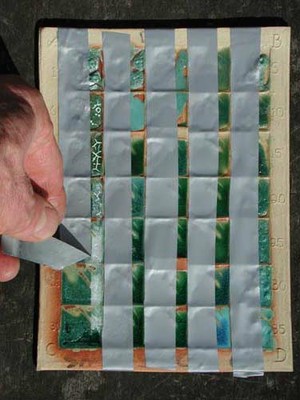
We can use grid tiles to test for stability. Strips of vinyl tape have been cut and carefully adhered to the tile to cover about three quarters of the fired glaze in each square cell. The tile was then soaked in vinegar for 3 days. (This test is outlined in "Mastering Cone 6 Glazes" by Ron Roy and John Hesselberth.) The tape is then removed (see Image 1) and thoroughly dried out.
Image 1: Peeling the Tape from the Grid Tile
If any difference is visible between the taped over and exposed areas within a cell, this is an indication the glaze is not stable in acid. (See Images 2 and 3.) Be aware however that a lack of any visible difference does NOT guarantee stability.
Image 2: The Grid Tile after the tape has been removed.
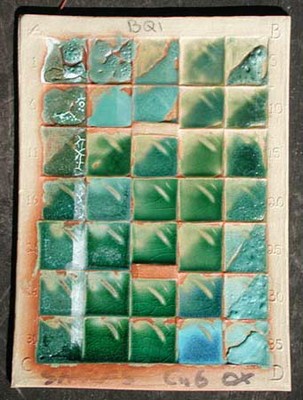
Corner A - Top left are high alumina glazes.
Corner B - Top right glazes are high in both alumnina and silica, which means low in flux.
Corner C - Bottom left are high flux glazes.
Corner D - Bottom right are high silica glazes.
Image 3: Close-up of the C-corner which is high in fluxes, and low in alumina and silica.
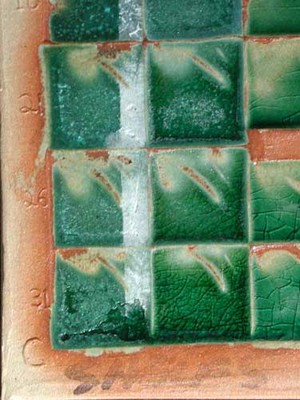
It is obvious from the grid that the low silica glazes (along the left hand side) are quite unstable in the acid.
Image 1: Peeling the Tape from the Grid Tile
If any difference is visible between the taped over and exposed areas within a cell, this is an indication the glaze is not stable in acid. (See Images 2 and 3.) Be aware however that a lack of any visible difference does NOT guarantee stability.
Image 2: The Grid Tile after the tape has been removed.
Corner A - Top left are high alumina glazes.
Corner B - Top right glazes are high in both alumnina and silica, which means low in flux.
Corner C - Bottom left are high flux glazes.
Corner D - Bottom right are high silica glazes.
Image 3: Close-up of the C-corner which is high in fluxes, and low in alumina and silica.
It is obvious from the grid that the low silica glazes (along the left hand side) are quite unstable in the acid.
Monday, October 19, 2009
NATIVE AMERICAN POTTERY IN NEW ENGLAND
Pottery was first used by New England Native Americans about 3,000 years ago. During the Archaic period, groups of people scheduled their movements into a seasonal cycle in accordance with the seasonal abundance of particular resources. A group might aggregate in a large village by the river or coastline during the summer harvesting migrating fish or now-stabilizing shell-fishing beds, and then break into smaller groups into the interior uplands to take advantage of winter hunting. Marking the beginning of the Early Woodland period, 2,700 years ago, groups of people started staying at the same village site longer than a single season. People might stay for an entire year or perhaps longer, while small task groups still used interior upland areas for temporary camps or workstations. Experimentation with maize-bean-squash horticulture and plant cultivation allowed, and required, a core group of people to remain longer in one place. By the time of European contact, Native Americans were staying in one waterside village for about ten year at a stretch. After a decade or so the settlement would move to another place along the river. Among the reasons for moving would be an eventual shortage of locally available firewood, and build up of midden waste and vermin at the previous location.
New England pottery is very fragile. When pottery is found at archeological sites in New England, it is usually fragmented into many small pieces. The low firing temperatures, unrefined paste and natural state of clay used to make pots, produced brittle vessels which could easily break. Before settling down into semi-permanent villages, it was not practical to transport ceramic pottery during frequent seasonal moves. Before the use of pottery, sturdy stone bowls were used, but because of their great weight, the bowls were often left (cached) at a village site that would be returned to in subsequent seasons.

Pottery is assumed to have been made by women, there are few early historic references to men making pottery. All the women would learn to make pottery, there is no evidence for pottery specialization (pottery made only by a single person or village family). Maintaining a livelihood of hunting, gathering, and horticulture, full-time professions would take energy away from daily subsistence activities, as every member needs to devote time to the daily food quest. Without such specialization, an artist can still find creative expression within the realm of everyday life, based on their daily experiences. Because Native Americans in southern New England organized themselves to move from one non-permanent settlement to another, their art focused on the decoration of utilitarian objects, which were carried along, left for later use or buried with the deceased. Through the perfection and embellishment of these items, Native Americans found not only a means of individual expression, but they also discovered a way to communicate important cultural symbols.
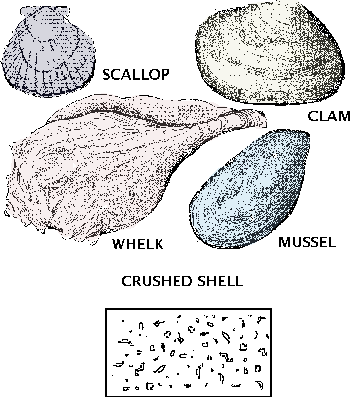
Natural clays formed when minute particles carried by streams sank and settled in still water ponds. For Native Americans to use natural clay dug from pond sides, river banks or ocean cliffs it had to be plastic enough to be bent or stretched into a coil without breaking or cracking. Often the clay had to be specially prepared. Native Americans added temper, crushed shell, sand, crushed fired-pottery, or even plant material to fine homogenous clays to help pottery withstand the shock of rapid-temperature changes and open flames. In preparing to make a pot all impurities were removed from the clay and any trapped air pockets or bubbles had been removed by wedging or kneading the clay, only then was the clay ready for rolling into coils for construction of a pottery vessel.
Native Americans in New England started making a pot by pinching a small ball of clay into a dish shape and placing it in a hollow in the earth. Turning the vessel during production, coils of clay were successively added to the interior of the vessel wall. The coils were pinched or pressed and smoothed into the previous coil, which welded the coils of clay together. The coiling process spiraled upwards until the desired form was achieved, at which point the vessel was paddled with a cord-wrapped stick to further compress and cement the clay, and give the pot it's finished form. Ceramic pots made by Natives of the Eastern Forest had slightly pointed, and later in time globe-shaped bottoms, like the bottom half of an egg . The rounded bottoms of the pots were perfectly suited to the uneven surfaces of the woodlands, and remained upright easily when placed in a hollow or upon rocks.
Pottery was fired outside in a shallow pit, without the use of an enclosed kiln. Temperatures in wood firings probably reached 1500o. After firing, pottery pieces are as hard as rock and can last for thousands of years buried in the earth.
At first pots were used mainly for cooking, but later in time pots were used to store foods as well. Pottery mainly consisted of cooking vessels, but miniature pots, pipes, beads and figurines were also made. Miniature pots (½ foot to 1 inch diameters) have been found by archaeologists working in New England. In Rhode Island, Archaeologist William Simmons unearthed small pots that were buried with 17th century Narraganset. It is likely small pots were used to prepare special foods required of young child, who may have been recently weaned, and would subsequently be needed by the child in their journey after death.
In addition to those made of stone, smoking pipes made of clay have been recovered from Early, Middle, and Late Woodland Period archaeological sites in New England. A variety of plant materials, primarily sacred aboriginal tobacco, were smoked for their curative values, and probably for recreation. The motifs and designs found on clay pipes are similar to those found on clay pots. Some pipes made with clay bowls and metal stems.
Pieces of pottery found by archaeologists can tell much about the way people lived long ago. Pottery can tell archaeologists about a peoples' artists and their tools, and also about how and what they cooked and ate. Decoration and style tell us about who made the pottery and the ties between different groups of people.
The changing shapes of pots, or vessel forms of southern New England pottery over time reflected the concurrent changes in food types and cooking methods. Early pointed-bottom pots, designed to sit directly on the fire, are best for quickly boiling meat and other food. Later rounded-bottom pots were designed to be farther from the fire for slower simmering of a variety of grains and vegetables in addition to meat. The constricted necks of later pots allowed the pot to be suspended with cords over the fire and the amount of liquid lost from the simmering food was also reduced.
Decorations were then applied, stamped or incised, and the body of the pot was often smoothed over. Various tools were used by Native Americans of southern New England to decorate their pots, including carved antler modeling tools, toothed combs, pointed sticks, scallop and probably other shells, nets and textiles to impress, wooden or shell scraping tools, and burnishing stones. Clay pots were decorated with designs and motifs used for other forms of art like metal-working, weaving, and even face painting. These shared designs encompass zones broken-up into triangles, zig-zags, and dots. Between 3,000 and 1200 years ago, designs and pottery styles appeared over much of southern New England with showed little variation from one area to the next, suggesting that these designs were shared by many different groups of people.
By the end of the Middle Woodland Period, 1200 years ago there was an increase in the diversity and complexity of designs placed on pottery. As the Native American population in southern New England increased and groups began to live in one place for longer periods of time, there is a corresponding increase in the stylistic diversity of ceramic decorations. This correspondence may reflect a need for groups of Native Americans to express their own family/village identity in the face of encroaching neighbors.
The designs applied to Late Woodland pottery, made by Mohegan, Pequot and Narragansett tribes in the historic period, preserve design elements from earlier times, including incised and stamped zones of horizontal, vertical, and triangular or zig-zag elements. In examples from the historic Mohegan Fort Shantok site, the pots have a unique sculptural quality which includes modeling of the vessel surface to raise lobes below the vessel collar, and elaborately formed castellated rims with one or more projecting points. Many of the later modeled, castellated decorations depict images of birth, fertility and other feminine qualities.
William Wood noted in 1634 that: "Hence likewiƒe our Indians had their pots wherein they uƒed to ƒeeth their victuals before they knew the uƒe of Braƒƒe"; kettles made of iron, brass and copper acquired in trade became more popular than traditional ceramic vessels. Many reasons lead to the decline of Native pottery production, metal kettles were sturdier and more portable than traditional pottery, and when they were damaged, could be repaired using sheet metal acquired in trade with Europeans. During the Fur Trade and Colonial-Native wars, time expended in pursuit of furs and producing wampum tributes took energies away from many traditional craft industries. Metal kettles and other trade items were soon adopted by Native Americans into traditional cultural roles. By the late 17th century metal pots and other European items even replaced many traditional items, such as clay pots, in burial offerings.
New England pottery is very fragile. When pottery is found at archeological sites in New England, it is usually fragmented into many small pieces. The low firing temperatures, unrefined paste and natural state of clay used to make pots, produced brittle vessels which could easily break. Before settling down into semi-permanent villages, it was not practical to transport ceramic pottery during frequent seasonal moves. Before the use of pottery, sturdy stone bowls were used, but because of their great weight, the bowls were often left (cached) at a village site that would be returned to in subsequent seasons.
Pottery is assumed to have been made by women, there are few early historic references to men making pottery. All the women would learn to make pottery, there is no evidence for pottery specialization (pottery made only by a single person or village family). Maintaining a livelihood of hunting, gathering, and horticulture, full-time professions would take energy away from daily subsistence activities, as every member needs to devote time to the daily food quest. Without such specialization, an artist can still find creative expression within the realm of everyday life, based on their daily experiences. Because Native Americans in southern New England organized themselves to move from one non-permanent settlement to another, their art focused on the decoration of utilitarian objects, which were carried along, left for later use or buried with the deceased. Through the perfection and embellishment of these items, Native Americans found not only a means of individual expression, but they also discovered a way to communicate important cultural symbols.
Natural clays formed when minute particles carried by streams sank and settled in still water ponds. For Native Americans to use natural clay dug from pond sides, river banks or ocean cliffs it had to be plastic enough to be bent or stretched into a coil without breaking or cracking. Often the clay had to be specially prepared. Native Americans added temper, crushed shell, sand, crushed fired-pottery, or even plant material to fine homogenous clays to help pottery withstand the shock of rapid-temperature changes and open flames. In preparing to make a pot all impurities were removed from the clay and any trapped air pockets or bubbles had been removed by wedging or kneading the clay, only then was the clay ready for rolling into coils for construction of a pottery vessel.
Native Americans in New England started making a pot by pinching a small ball of clay into a dish shape and placing it in a hollow in the earth. Turning the vessel during production, coils of clay were successively added to the interior of the vessel wall. The coils were pinched or pressed and smoothed into the previous coil, which welded the coils of clay together. The coiling process spiraled upwards until the desired form was achieved, at which point the vessel was paddled with a cord-wrapped stick to further compress and cement the clay, and give the pot it's finished form. Ceramic pots made by Natives of the Eastern Forest had slightly pointed, and later in time globe-shaped bottoms, like the bottom half of an egg . The rounded bottoms of the pots were perfectly suited to the uneven surfaces of the woodlands, and remained upright easily when placed in a hollow or upon rocks.
Pottery was fired outside in a shallow pit, without the use of an enclosed kiln. Temperatures in wood firings probably reached 1500o. After firing, pottery pieces are as hard as rock and can last for thousands of years buried in the earth.
 |
Miniature Pot. |
In addition to those made of stone, smoking pipes made of clay have been recovered from Early, Middle, and Late Woodland Period archaeological sites in New England. A variety of plant materials, primarily sacred aboriginal tobacco, were smoked for their curative values, and probably for recreation. The motifs and designs found on clay pipes are similar to those found on clay pots. Some pipes made with clay bowls and metal stems.
 |  |
 |
The changing shapes of pots, or vessel forms of southern New England pottery over time reflected the concurrent changes in food types and cooking methods. Early pointed-bottom pots, designed to sit directly on the fire, are best for quickly boiling meat and other food. Later rounded-bottom pots were designed to be farther from the fire for slower simmering of a variety of grains and vegetables in addition to meat. The constricted necks of later pots allowed the pot to be suspended with cords over the fire and the amount of liquid lost from the simmering food was also reduced.
Decorations were then applied, stamped or incised, and the body of the pot was often smoothed over. Various tools were used by Native Americans of southern New England to decorate their pots, including carved antler modeling tools, toothed combs, pointed sticks, scallop and probably other shells, nets and textiles to impress, wooden or shell scraping tools, and burnishing stones. Clay pots were decorated with designs and motifs used for other forms of art like metal-working, weaving, and even face painting. These shared designs encompass zones broken-up into triangles, zig-zags, and dots. Between 3,000 and 1200 years ago, designs and pottery styles appeared over much of southern New England with showed little variation from one area to the next, suggesting that these designs were shared by many different groups of people.
By the end of the Middle Woodland Period, 1200 years ago there was an increase in the diversity and complexity of designs placed on pottery. As the Native American population in southern New England increased and groups began to live in one place for longer periods of time, there is a corresponding increase in the stylistic diversity of ceramic decorations. This correspondence may reflect a need for groups of Native Americans to express their own family/village identity in the face of encroaching neighbors.
 |
(reproduction). |
William Wood noted in 1634 that: "Hence likewiƒe our Indians had their pots wherein they uƒed to ƒeeth their victuals before they knew the uƒe of Braƒƒe"; kettles made of iron, brass and copper acquired in trade became more popular than traditional ceramic vessels. Many reasons lead to the decline of Native pottery production, metal kettles were sturdier and more portable than traditional pottery, and when they were damaged, could be repaired using sheet metal acquired in trade with Europeans. During the Fur Trade and Colonial-Native wars, time expended in pursuit of furs and producing wampum tributes took energies away from many traditional craft industries. Metal kettles and other trade items were soon adopted by Native Americans into traditional cultural roles. By the late 17th century metal pots and other European items even replaced many traditional items, such as clay pots, in burial offerings.
Sunday, September 27, 2009

Saturday, September 26, 2009
PREPARATION OF CLAY FOR NATIVE AMERICAN POTTERY
| CLAY PREPARATION | |
| CLAYS can be found near the ocean or by inland streams and ponds. The clay formed when tiny bits of dirt carried by streams sank and settled in still water ponds. Clays must be plastic enough to be rolled into a coil and bent without breaking. | |
| ADDING TEMPER | |
 | |
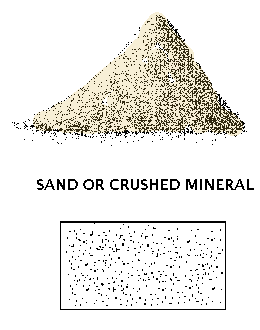
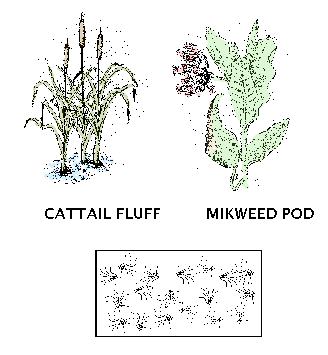
 | TEMPER may be crushed shell, sand, broken pottery bits, or plant material. Up to 1/10 of the clay mixture can be made up of temper for very fine natural clays. Tempering pottery makes it able to take rapid changes in temperature when placed in a fire. |
| WEDGING CLAY AND SPIRAL WEDGING | |
 | WEDGE clay to make the mix even and to help remove air bubbles from the clay. If air is not removed from the clay pottery may break or crack when dried and fired. SPIRAL type of wedging clay is an efficient way to mix clay. Keeping the clay in a cone or shell shape, first pull a melon-sized piece of clay toward you. Second, push down and away from you while giving the cone of clay a slight turn. |
CERAMIC HAND PRINTS
childhood is a time to be treasured - for both parents and children. Time goes by so fast and we get caught up in our busy day to day hustle and bustle that we often forget to stop and smell the flowers. Before you know it, our kids have all grown up and gone off to college and then to lead their own lives. When that happens, we begin to treasure all the memories and little things we've kept as reminders of that wonderful time. Suddenly photos, baby shoes, art projects and stuff that you did together become priceless objects.
One of the best ways to capture and remember those precious memories our children as they were is to make ceramic hand prints. This is a technique where your child's hand or footprints are embedded into soft clay. The ceramic print may be customized any way you want, including any phrases, poems or designs. They are then baked in a kiln and glazed - exactly like other ceramic products. The result is a special moment frozen in time (ceramic) which you can keep.
Ceramic Hand Prints can be turned into a full time business, but they are usually offered as an added service by gift or craft stores. However, if you plan to run this as a side business during the weekends, then it can be a really fun way to make money and provide people with a treasured memory. You will need a kiln, supply of clay, art materials and sample designs to begin with. Making Ceramic Hand Prints requires a bit of learning at first, but the good thing is you can learn the skill. Pawprints and Pitterpats are two business opportunity providers that teach you how to create and market Ceramic Hand Prints.
It's possible to set up shop in a number of ways. If you run your Ceramic Hand Prints business part-time you could set up a small workshop in your garage where clients can drop by. Another way to increase your orders is to set up shop in a mall. The amount of space you need will also depend on the size of your kiln so remember that a large space also means your fixed cost increases. One work around to this problem is to set up a small kiosk where you can do the actual hand imprints on site. You can also perform any customization on the spot. The only difference would be that after your customer gives their okay, you will carefully pack their clay imprints in a crush proof container, to be tranported back to your home workshop for kiln firing and glazing. Your customer can then pick up their finished Ceramic Hand Imprints a couple of days later. Working this way also allows you to correct any mistakes that you may have missed in the imprints.
Ceramic artists display pieces made from earthenware, stoneware and porcelain clay
CERAMIC artist and art consultant Frankie YeeVia believes that ceramics is a unique art form that is yet to be fully developed in Malaysia, and hopes to improve and promote ceramics among the local society.
“The colours used for ceramics won’t fade and the pieces can be acquired as part of a person’s art collection,” the 45-year-old said at an exhibition called In the Garden.
It features works by six ceramic artists from YeeVia Pottery Studio that are inspired by the flora, fauna and elements found in gardens.
 Inspired by flowers: Khoo’s works, like this piece called `Disclosure 2’, were inspired by her study of flowers, particularly how the flowers construct themselves to entice insects to fertilise their seeds.
 The works are made from earthenware, stoneware and porcelain clay, and offer an opportunity to view ceramics as an art form.
“This exhibition showcases works done by my students and me. I wanted them to get a feel of the entire process of being an artist – from learning about arts and crafts to interacting with the public,” YeeVia said.
His Journey of Cubes is a series of vessels that depict man on a journey of challenges.
 Fauna as inspiration: A piece by Laubichler called `Bug No Fly’ from her collection that was inspired by the vibrant colours and varying shapes of insects and garden creatures.
 The lines of life etched into the vessels describe a man’s life from the beginning to the end.
YeeVia explained that this series reflected his journey of discovering his Sino-Kadazan heritage, and depicted both masculine and feminine elements in the edges and curves respectively.
“The asymmetrical patterns on the vessel bodies contrast with the smooth swelling of the stoppers that are phallic symbols for fertility and malehood,” said the Southern Illinois University Masters of Fine Art graduate, whose concept was to create a nirvana-like setting in the garden.
Liz Joo’s My Sweet Garden collection features a little garden of tableware concept to create the feeling of having tea or dinner in the midst of nature.
“These functional tableware go by themes like lilies, leaves and water. My favourite is the waterfall series as I like the sound and shape of water flowing,” said the 42-year-old Korean, who took inspiration from the variety of Mother Nature’s shapes and colours.
“This works can be used not only to serve food and drinks, but also to enhance the taste and give pleasure to those who use them,” said the former lecturer, who combined her love for cooking and ceramics for her works.
Lim Ai Lin’s collection – The Gloria Chronicles – is a story about life’s journey and various issues that one faces in life, and is represented by a fictitious character called Gloria.
“There were three main elements I used in my works: the boat-like shape and landscapes we encounter as we travel through life, carvings to depict effects left by life’s experiences, and words like poetry and prose to verbalise what we feel as we’re grappling with issues,” she said.
The 31-year-old cited the example of a piece called Questions that queries the restrictions and rules that have been set by society, and another called Petit Bateau 1 – part of a series of boats that describes the hesitance and acceptance of going through change.
A trip to the Butterfly Garden in Kuala Lumpur was what inspired Elke Laubichler, 45, for her Encounters with Metaphoric Creatures series.
“The vibrant colours and varying shapes of the bugs and beetles I saw are metamorphosed into organic-shaped vessels that evoke the feel of warriors, pagodas and mythic creatures, while some become fanciful and bird-like.
“Certain elements the same, such as the colours and patterns, then gave my own interpretation,” said the German who picked up arts and crafts to ease her mind from her accounting work.
Niki Cheong YL turned her fascination for the winged Dipterocarp seeds into her Seeds and the City series.
“These winged seeds of hope, new life and energy fascinate me, a witness to the city’s ruthless expansion that has left little space for trees to grow.
“These pieces were mounted to look like they were floating away from the background, and look as if they are notes in a musical score.”
Khoo Gaik Sim, a full-time artist in her 50s, said her Disclosure series was inspired by her study of flowers.
“I homed in on how the flowers constructed themselves to entice insects to fertilise their seeds located at the secret centres.
“My sculptural vessels speak of this seduction of the flowers,” said Khoo, who feels that flowers are metaphors for human life.
“My works are an expression of human sexuality and how seductive life can be. On another level, these sculptures refer to the secret centres within us, and which we choose to disclose or hide.”
Norwegian ceramic art goes modern
THE making of glass and ceramics is a tradition in Norway. The oldest glassworks in the country is Hadeland Glassverk which was founded in 1762 and is still in existence today.
Although some craftsmen have chosen to maintain the craft in their traditional objects such as plates, pots and vases, many have injected new ideas to produce contemporary pieces.
These contemporary pieces are no longer placed on dinner tables, instead they decorate shelves and become showpieces in galleries.
“Norwegian-glassmaking dates back to the 18th century, when local farmers gave up tilling the soil to work together with glassblowers, engravers and other master craftsmen from abroad.
“Similarly, the ceramic arts are part of an age-old tradition of crafmanship and the field of ceramics in Norway has been dominated bycraftspeople whose roots are in pottery. Pleasing sight: Visitors admiring the display.
 “But since 1945, Norwegian contemporary glass art and ceramics have particularly undergone interesting developments,” said the ambassador of the Royal Norwegian Embassy to Malaysia Arild Braastad.
He said contemporary glass and ceramic artists had used their creativity and imagination, turning the pieces into decorative art.
Some artists even chose their work as a medium to express their feelings and emotions on certain issues.
Their work features images of absurd and surrealistic figures instead of the beautiful glassware and ceramics that are commonly placed on dining table.
Such artworks are now on display at Wisma Soka Gakkai Malaysia in Jalan Bukit Bintang until Sunday.The show, jointly organised by the Norwegian Embassy and Soka Gakkai Malaysia, features more than 50 pieces of glass and ceramic works by Norwegian artists.
Most of the artworks in the show use trolls, which is a traditional Norwegian supernatural figure, as the central theme.
The Norwegian Contemporary Glass and Ceramic Exhibition has travelled the world since 2000. The pieces have been shown in several places including New York, Tokyo, Beijing, Sydney and Helsinki.
“It is good that it is now presented in Malaysia.
“I am delighted that the exhibition is being exhibited for the second time in Kuala Lumpur.
“Last year it was held at the National Art Gallery and now here at Soka Gakkai,” said Braastad.
The pieces are done by both established and budding artists in the country.
Braastad added that the exhibition was being held to share the uniqueness and wide range within contemporary glass-art and ceramics in Norway with the world. He also hoped that the show could provide some inspiration to local artists and art communities in Malaysia.
Subscribe to:
Posts (Atom)

